
5 Common Mistakes Beginners Make While Learning Python (and How to Avoid Them)
# 5 Common Mistakes Beginners Make While Learning Python (and How to Avoid Them) ## Introduction ## 1. Memorising Syntax Instead of Understanding Concepts ## 2. Skipping Hands-On Practice ## 3. Being Afraid of Error Messages ## 4. Jumping Between Too Many Learning Resources ## 5. Not Building Real Projects ## Quick Tips for Python Beginners ## Conclusion
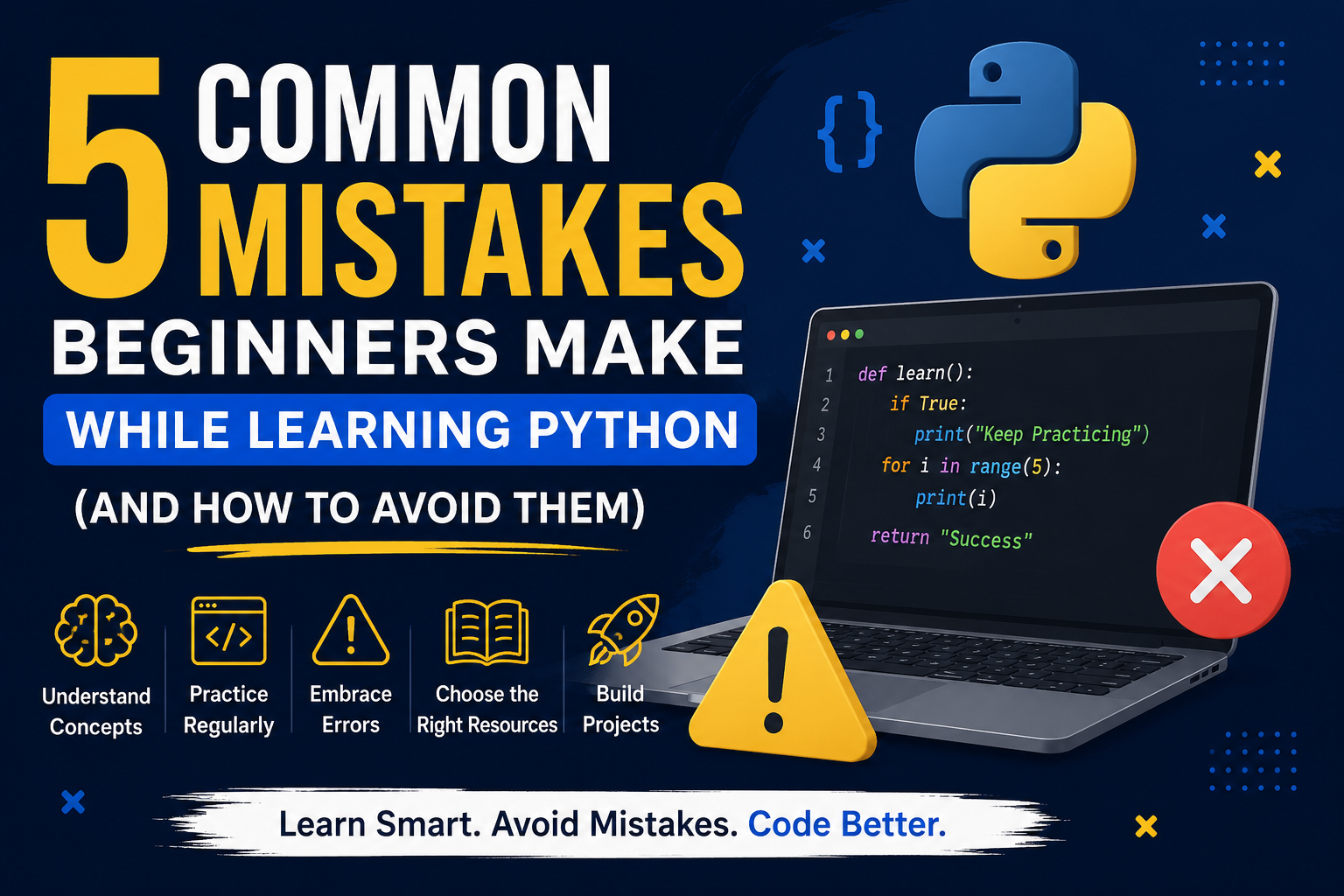
5 Common Mistakes Beginners Make While Learning Python (and How to Avoid Them)
Introduction
Python is one of the most beginner-friendly programming languages in the world. Its simple syntax and wide range of applications make it a popular choice for students, developers, and aspiring data scientists. However, many beginners make common mistakes that slow down their learning journey.
The good news is that these mistakes are completely normal. By recognising them early, you can learn Python more efficiently and build a stronger foundation.
1. Memorising Syntax Instead of Understanding Concepts
Many beginners spend hours trying to memorise Python syntax. While syntax is important, understanding concepts such as variables, loops, functions, and conditions is much more valuable.
How to avoid it:
Focus on understanding why the code works.
Practise each concept with small coding exercises.
Solve simple problems instead of only reading theory.
2. Skipping Hands-On Practice
Watching tutorials alone does not make you a programmer. Programming is a practical skill that improves only through consistent practice.
How to avoid it:
Write code every day, even for 30 minutes.
Build small projects like a calculator or to-do list.
Revise previous concepts by applying them.
3. Being Afraid of Error Messages
Error messages can seem frustrating at first, but they are actually valuable learning tools. Every programmer encounters bugs and errors.
How to avoid it:
Read the error message carefully.
Search for unfamiliar errors online.
Treat every error as a learning opportunity.
4. Jumping Between Too Many Learning Resources
Many beginners switch from one YouTube channel to another or buy multiple courses without finishing any of them. This often creates confusion instead of progress.
How to avoid it:
Choose one reliable course or tutorial.
Complete it before starting another.
Stay consistent with your learning path.
5. Not Building Real Projects
Learning concepts is important, but applying them through projects is what builds real programming skills.
How to avoid it:
Create projects after every major topic.
Start with simple applications.
Upload your projects to GitHub to build your portfolio.
Quick Tips for Python Beginners
Code consistently every day.
Focus on understanding concepts.
Build projects regularly.
Learn from mistakes instead of fearing them.
Stay patient and enjoy the learning process.
Conclusion
Every Python developer started as a beginner. Making mistakes is completely normal and is an essential part of learning. Instead of aiming for perfection, focus on consistent practice, building projects, and improving a little every day. With time, you'll become more confident and capable of solving real-world problems using Python.
Remember, success in Python comes from consistency, not perfection.


